Future Proof Tech Briefing · August 2026
The Target Audience Is Me
Why I built my own fitness coach — and what that has to do with the upheaval in our industry.
Five fitness apps. Oura for sleep, Hevy for strength training, Yazio for nutrition, Renpho for body composition, Apple Health as the collection point. Every single one of them is good. And yet none of them ever really fit.
The problem was never quality. The problem is that each of these apps was built for someone else — and each has its own opinion about me. Oura has a recovery model, Hevy a progression model, Yazio a nutrition model. None of them talks to the others, and none of them can be married to my own model. Five apps, five silos, five foreign assumptions about what proper training looks like.
In the past, I would have had to live with that. Software for a target audience of one person never paid off.
That calculation no longer holds.
What I built
IDUN — named after the Norse goddess whose apples keep the gods young — is my personal AI coach for training, nutrition, recovery, and longevity. A native iOS app for iPhone and iPad, built with Claude Code, powered by Anthropic’s Claude API.
The app bundles all of these data sources — recently joined by a HILO wristband whose continuous blood pressure readings flow in as well — into one context and sends it to Claude. What comes out is a coach that decides every morning, based on HRV, resting heart rate, sleep, and training history, whether today calls for full throttle, adjusted training, or a rest day. A coach that builds training plans and manages progression. A coach that counts reps in Gym Mode on the iPad — by voice, by camera pose analysis, or via two hand-soldered ESP32 sensors on my gloves that answer to the names Geri and Freki, Odin’s wolves.
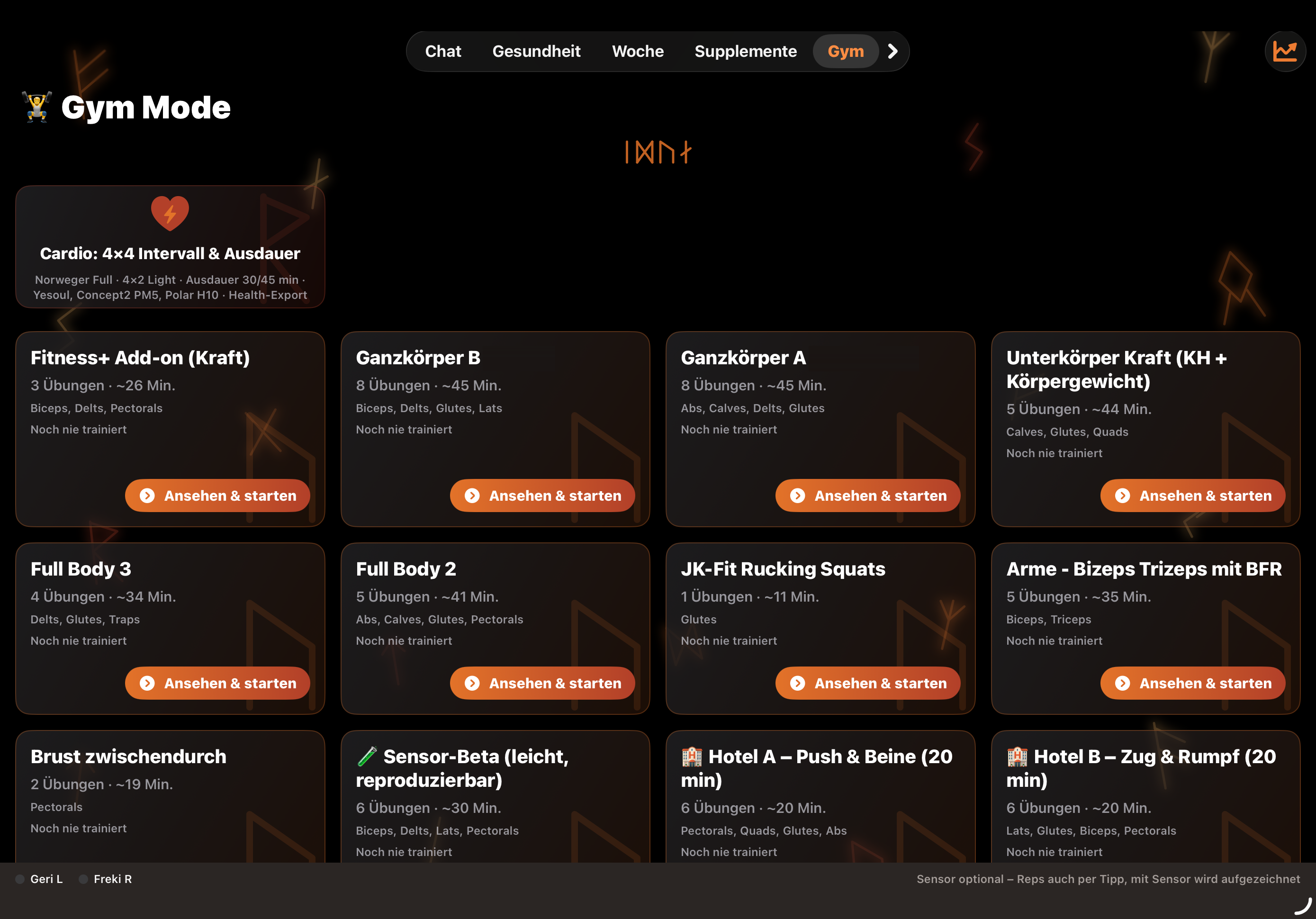
Gym Mode on the iPad: training plans, cardio programs — and, bottom left, the two sensors Geri and Freki.
Nobody builds something like this as a product. The market for exactly my combination of goals, devices, and convictions has a size of one. That is precisely why this app could never be bought — and precisely why I built it.
And one point that matters more to me than any feature: There is no backend. Everything runs on-device. My health data only leaves the device for the individual API call, and syncing between iPhone and iPad runs exclusively through my private iCloud database. No user database, no server, no account with any provider. Your own ideas, your own data — for me, that is not a marketing slogan but an architectural decision.
What it costs — and why the math works differently
This is where it gets interesting, because this is where classic project thinking breaks down.
Development runs on my Claude Max subscription, which I use for several projects anyway. The IDUN share cannot be cleanly separated out, and that is the point: Creation is a flat rate. An additional idea costs me no additional money — only the time to formulate it and judge the result.
What remains variable is operations: currently around 15 euros a month in API costs. For comparison, here is what I pay or have paid for the off-the-shelf apps: Hevy Pro at 60 euros a year, Yazio at 7 euros a month, MyFitCoach at 120 euros a year, HealthFit at 5 euros a month — around 27 euros a month in total. All of them were or still are in use, and IDUN is replacing them piece by piece.
Other tools deliberately stay — but upgraded. I still use the Oura Ring as a data source, and I still train strength and endurance with Apple Fitness+. The catch: Fitness+ delivers no exercise details to Apple Health — which exercises, which muscle groups, all of it stays invisible. IDUN closes that gap, analyzes the sessions in more depth, and adds targeted supplementary training on top. So IDUN is not a declaration of war on the apps. It is the instance that decides, tool by tool: replace or refine.
The result of this math deserves a second read: The tailor-made coach costs less to run than the standard subscriptions it replaces. And the comparison is not even like for like — because what IDUN can do was not for sale at any price. I pay less for more, and the “more” is the gap the market is structurally unable to close.
And even these running costs are now optimizing themselves: with the latest Claude Code update and the /doctor command, API costs dropped from around 20 to around 15 euros a month — a quarter less, in one evening. The app reduced its own operating costs via a command. There is more to be had.
Classic project accounting asks: what did it cost until it was finished? For IDUN, that question makes no sense, because:
This app will never be finished. And that is the point.
Something is always being added, dropped, or replaced. The roadmap from spring has been fully implemented — and the next construction sites are already lined up next to it. An idea during the morning workout is running on the iPad by evening.
Classic software economics rests on three assumptions: a fixed scope, a completion date, depreciation over a lifecycle. None of the three holds here anymore. The relevant metric is not what the project cost, but what a single change costs — and how long it takes from idea to running implementation. For me: usually one evening, marginal costs near zero.
In fairness, the flip side belongs here too. No fixed scope also means: nothing stops on its own. Scope creep has no natural brake, the maintenance burden grows with every module, and this project’s bus factor is exactly one. The old project accounting made precisely these costs visible — the new one hides them. Anyone who fails to price that in is quickly and cheaply building themselves a problem.
And one more limit: I have more than 25 years of IT behind me. The tools dramatically lower the cost of implementation — not the demands on judgment. Anyone who cannot judge whether the generated training load model is physiological nonsense will quickly and cheaply build something wrong.
Which is why I bring in the judgment I do not have myself: through IDUN I regularly reflect with a doctor friend, who also contributes lab values as context, and my cardiologist keeps an eye on what the coach makes of the data. IDUN does not replace medicine — it makes my conversations with doctors better, because I show up with 90-day trends and correlations instead of snapshots and gut feeling. In software, I am the final authority. In health, the professionals remain so.
Why the code is not public (yet)
The obvious question: where is the repo?
Still private — and the reason is a lesson in itself. Open source is not a click on “public”. Precisely because this app is radically personal, my life is embedded in the code: training data, profile values, configurations. Before the repo goes public, real decisions have to be made — which license, which data gets neutralized, what the complete commit history reveals. We built the architecture from the start so that the personal data lives in a single place and can be cleanly extracted. Still: once published is irreversible, so this step happens with deliberation, not with enthusiasm.
What I can already say: IDUN is not for sale, and it will not become a product. No monetization, no user base, no pitch deck. That eliminates the entire long tail that makes software expensive — product-market fit, support, privacy policies for third parties, scaling. That is not a missed opportunity. That is the feature.
The bigger shift
Anyone following my RAMmageddon series knows one side of this development: infrastructure is getting more expensive and more concentrated — memory prices are exploding, and the bulk of the chips goes to a handful of hyperscalers. The hardware world is consolidating upward.
For me, IDUN is the proof of the countermovement on the other side of the stack: Software creation is individualizing downward. While compute becomes a scarce corporate commodity, the threshold for building something radically your own on top of that compute is falling at the same time — with your own ideas and, done right, with your own data that never leaves your own device.
In the kitchen table moment, I described how hardware price transparency arrives in people’s everyday lives. This is the same movement, one level up: no longer just visibility is being consumerized, but creation itself. Software for a target audience of one has become economically viable.
The most interesting software of the coming years will not be in the app stores. It will run on individual devices, built by individuals, for audiences of one.
Mine carries a name from Norse mythology, counts my reps, and costs me less than the subscriptions it is replacing, one by one.
What about you — is there that one tool you would build for yourself if effort no longer mattered? I am curious, because that question is no longer hypothetical.
Jens Klasen is a Tech Evangelist at CID GmbH and writes in the Future Proof Tech Briefing about the upheaval in enterprise IT. You can find all previous installments in my newsletter and at klasen.ai.